Process Structure
The Basic Elements of RUP 
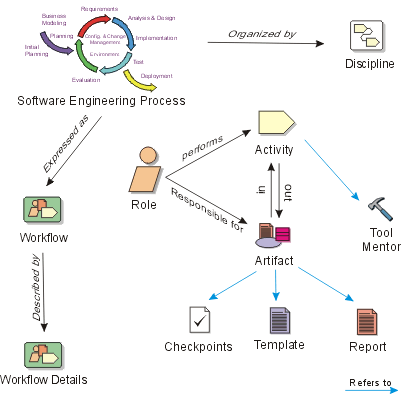
Click on an item in this image to get more information about that key process element in RUP.
Software Engineering Process
A process is a set of partially ordered steps intended to reach a goal. In software engineering, the goal is to build a software product or to enhance an existing one. In process engineering, the goal is to develop or enhance a process. In RUP, these are organized into a set of disciplines (shown in the following figure) that further define the workflows and other process elements.
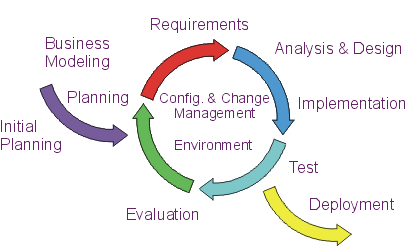
Expressed in terms of business modeling, the software development process is a business process; RUP is a generic business process for object-oriented software engineering. It describes a family of related software engineering processes that share a common structure and a common process architecture. RUP provides a disciplined approach to assigning tasks and responsibilities within a development organization. Its goal is to ensure the production of high-quality software that meets the needs of its end users, within a predictable schedule and budget. RUP captures many of the best practices in modern software development in a form that can be tailored for a wide range of projects and organizations.
When a software system is developed from its outset, the process is one of creating a system from requirements. But once the systems have taken form-or, in RUP terms, once the system has passed through the initial development cycle-any further development is the process of conforming the system to the new or modified requirements. This applies throughout the system's lifecycle.

The software-engineering process is the process of developing a system from requirements, either new (initial development cycle) or changed (evolution cycle).
